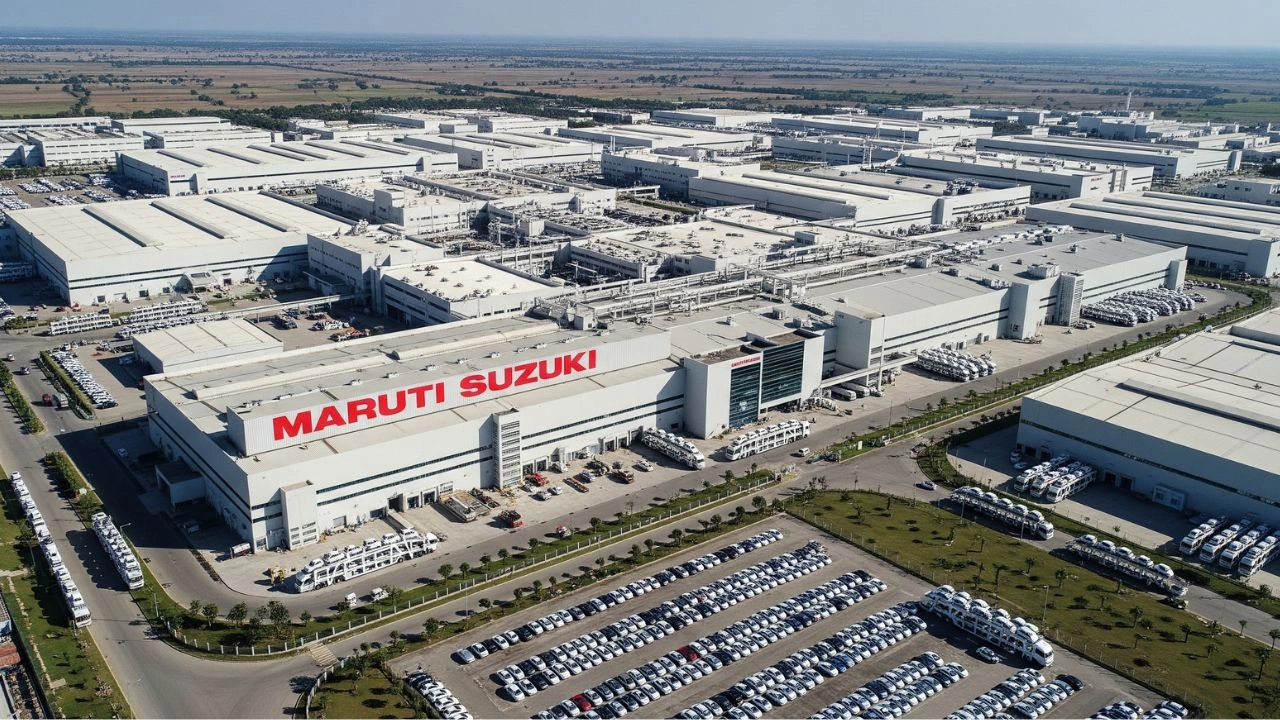
Maruti Suzuki Gujarat plant: Maruti Suzuki India Limited has announced a major expansion of its manufacturing footprint with plans to establish a new automobile production plant in Gujarat, reinforcing its long-term commitment to India as its global manufacturing base. The upcoming facility, which will become the company’s fifth manufacturing plant in the country, represents one of the largest automotive investments in recent years and signals Maruti Suzuki’s confidence in sustained demand growth in both domestic and export markets.
With an investment estimated at ₹35,000 crore, the new plant is expected to significantly enhance Maruti Suzuki’s production capacity, generate thousands of jobs, and further strengthen Gujarat’s reputation as one of India’s most important automotive and industrial hubs.
A Strategic Expansion in Gujarat
The new manufacturing facility will be located at the Khoraj industrial estate in the Gandhinagar district of Gujarat. Spread across approximately 1,750 acres of land, the project has been facilitated by the Gujarat Industrial Development Corporation (GIDC), highlighting the state government’s proactive role in attracting large-scale industrial investments.
This plant will be Maruti Suzuki’s second manufacturing facility in Gujarat, complementing the existing Hansalpur plant operated by Suzuki Motor Gujarat. Once operational, it will join Maruti Suzuki’s other Indian plants located in Gurugram, Manesar, and Kharkhoda in Haryana, creating a geographically balanced production network across northern and western India.
The choice of Gujarat is not accidental. The state offers strong infrastructure, proximity to ports, investor-friendly policies, and a well-developed automotive supply ecosystem. These factors make it an ideal location for large-scale vehicle production, particularly for export-oriented manufacturing.
Read Also: Thermal Runaway in EV Batteries: How Insurance Companies Assess Fire Risk
Investment 규모 and Long-Term Vision
The planned ₹35,000 crore investment underscores the scale and ambition of the project. This funding will be deployed over multiple phases, covering land development, plant construction, advanced manufacturing equipment, logistics infrastructure, and worker facilities.
Once fully completed, the Gujarat plant is expected to have an annual production capacity of 10 lakh vehicles (1 million units). This would make it one of the largest automobile manufacturing facilities in India, capable of producing multiple models across different segments.
Maruti Suzuki’s leadership has emphasized that the investment aligns with the company’s long-term growth strategy. Which includes expanding its product portfolio, increasing exports, and preparing for future technologies such as electrification and alternative fuels.
Boost to Employment and Local Economy
One of the most significant impacts of the new plant will be on employment. The project is expect to create around 12,000 direct and indirect jobs, spanning factory workers, engineers, logistics personnel, and administrative roles.
Beyond direct employment, the plant will generate substantial opportunities for ancillary industries, including component suppliers, logistics providers, tooling companies, and service vendors. This multiplier effect is expect to stimulate economic growth across Gandhinagar and neighbouring districts.
For Gujarat, the project reinforces its position as a preferred destination for automotive and manufacturing investments, while also supporting India’s broader “Make in India” and “Atmanirbhar Bharat” initiatives.
Strengthening India’s Automotive Manufacturing Ecosystem
Maruti Suzuki has long been the backbone of India’s passenger vehicle industry, accounting for a significant share of domestic car sales. The addition of a fifth manufacturing plant reflects the company’s expectation that India’s automotive market will continue to grow steadily over the next decade.
Rising incomes, improving road infrastructure, urbanization, and increased vehicle ownership in rural areas are all contributing to long-term demand. At the same time, India is emerging as a global manufacturing and export hub, especially for compact and fuel-efficient vehicles.
The Gujarat plant is expect to play a critical role in meeting both domestic demand and export commitments, particularly to markets in Africa, Latin America, Southeast Asia, and the Middle East.
Capacity Expansion to Support Future Models
While specific model details have not yet been announced, the new plant is likely to support multiple platforms and powertrains. This flexibility will allow Maruti Suzuki to respond quickly to market trends and regulatory changes.
Industry experts believe the facility could eventually produce:
- Compact and mid-size passenger cars
- SUVs and crossovers
- Hybrid and alternative fuel vehicles
- Export-focused models
The plant’s design is expect to incorporate modern manufacturing technologies, including automation, digital quality control systems, and energy-efficient processes.
Alignment with Environmental and Sustainability Goals
Sustainability is expect to be a core focus of the new Gujarat facility. Maruti Suzuki has increasingly emphasized environmental responsibility, and the upcoming plant is likely to reflect this shift.
Potential sustainability measures may include:
- Reduced water consumption through recycling systems
- Energy-efficient production lines
- Increased use of renewable energy sources
- Waste minimization and recycling initiatives
By adopting greener manufacturing practices, the company aims to reduce its environmental footprint while complying with evolving global and domestic emission standards.
Government Support and Policy Alignment
The project has received strong backing from the Gujarat state government, with senior officials participating in the investment agreement ceremony. The collaboration highlights the effectiveness of public-private partnerships in driving large-scale industrial development.
For the central government, the investment aligns with national priorities such as:
- Expanding manufacturing capacity
- Increasing exports
- Creating skilled employment
- Strengthening supply chains
The automotive sector remains a key contributor to India’s GDP and exports, and investments of this scale help reinforce the country’s position as a global manufacturing destination.
Maruti Suzuki’s Manufacturing Network in India
With the addition of the new Gujarat plant, Maruti Suzuki’s manufacturing footprint in India will include:
- Gurugram Plant (Haryana) – One of the company’s oldest facilities
- Manesar Plant (Haryana) – A major production and export hub
- Kharkhoda Plant (Haryana) – Recently commissioned with modern capabilities
- Hansalpur Plant (Gujarat) – Operated by Suzuki Motor Gujarat
- Khoraj Plant (Gujarat) – The upcoming fifth facility
This diversified network improves resilience against supply disruptions and allows Maruti Suzuki to optimize production and logistics across regions.
Competitive Landscape and Market Implications
The announcement comes at a time when competition in India’s passenger vehicle market is intensifying. Global and domestic automakers are expanding capacity, introducing new models, and investing heavily in technology.
By committing to such a large expansion, Maruti Suzuki is signaling its intent to defend and strengthen its market leadership, even as consumer preferences shift toward SUVs, advanced features, and cleaner powertrains.
The increased capacity will also allow the company to reduce waiting periods for popular models, improve supply chain efficiency, and respond faster to market demand.
Read Also: Porsche Cayenne Electric: Price, Range, Performance, Features & Complete Luxury EV Buying Guide
Long-Term Outlook for the Indian Auto Industry
The establishment of Maruti Suzuki’s fifth plant reflects broader optimism about the future of India’s automotive sector. Despite short-term challenges such as regulatory changes and economic cycles, long-term fundamentals remain strong.
Key drivers include:
- A large and growing population
- Increasing urban and rural mobility needs
- Government support for manufacturing
- Rising export opportunities
With investments like this, India is steadily positioning itself as not just a major car market, but also a global automotive manufacturing powerhouse.
Conclusion
Maruti Suzuki’s decision to build a new manufacturing plant in Gujarat marks a significant milestone in the company’s journey in India. With a massive investment, high production capacity, and strong employment potential. The project underscores Maruti Suzuki’s confidence in India’s economic growth and automotive future.
As the company prepares to expand its manufacturing capabilities, the new Gujarat plant is set to play a crucial role in shaping the next phase of Maruti Suzuki’s growth—supporting innovation, exports, sustainability, and long-term market leadership.
For India and Gujarat alike, the project represents a powerful vote of confidence in the country’s industrial ecosystem and its ability to support world-class automotive manufacturing.
1 thought on “Maruti Suzuki to Build New Gujarat Manufacturing Plant, Marking Its Fifth Production Facility in India”