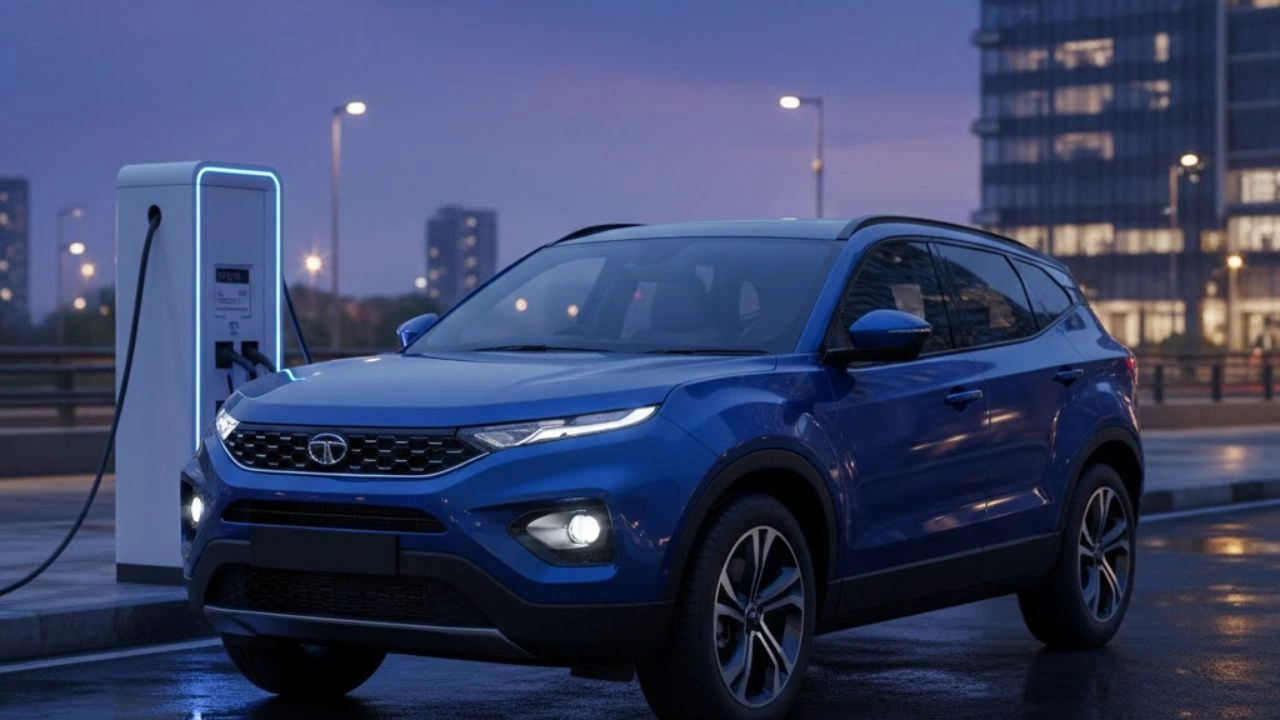
India’s premium electric SUV revolution gains momentum as Tata Harrier EV demand signals strong consumer confidence and market maturity.
The Indian electric vehicle (EV) landscape is evolving at an unprecedented pace. What began as a slow transition driven primarily by small urban electric cars and two-wheelers is now expanding into larger, more premium vehicle segments. At the center of this shift stands the Tata Harrier EV, a model that is rapidly emerging as a defining product in India’s premium electric SUV category.
Industry projections indicate that cumulative sales of the Harrier EV are likely to approach the 25,000-unit milestone by March 2026, a figure that reflects not only strong consumer demand but also a broader transformation in how Indian buyers perceive electric mobility. This moment represents far more than a simple sales statistic—it signals growing trust in high-value EVs, improved infrastructure readiness, and the beginning of a premium electrification era in India.
The Rise of Premium Electric SUVs in India
For years, India’s EV adoption story revolved around affordable hatchbacks and compact SUVs, supported by government incentives and urban commuting needs. While this strategy helped introduce electric mobility to the masses, it left a noticeable gap in the mid-size and premium SUV segments, where buyers expect performance, comfort, and long-distance usability.
The Harrier EV’s market traction demonstrates that this gap is finally closing. Consumers are no longer viewing EVs merely as fuel-saving city vehicles. Instead, they are beginning to see them as full-fledged primary cars capable of highway travel, family use, and premium ownership experiences.

Crossing—or even nearing—25,000 cumulative sales within a relatively short time frame suggests something deeper:
- Affluent buyers are embracing electrification.
- Range anxiety is gradually declining.
- Charging infrastructure confidence is improving.
Together, these factors are reshaping the Indian EV narrative from “experimental” to “mainstream aspirational.”
Read Also: EV Mitra Scheme 2025 India: Subsidy, Benefits, Eligibility & How to Apply
Strong Demand Reflects Changing Buyer Psychology
One of the most important insights behind the Harrier EV’s projected sales milestone is the shift in consumer mindset.
Earlier EV buyers were typically:
- Cost-focused
- Environment-motivated
- Limited to short-distance city driving
Today’s premium EV buyers are different. They prioritize:
- Performance comparable to diesel SUVs
- Advanced technology and connected features
- Brand trust and after-sales ecosystem
- Long-term running cost savings
The Harrier EV appears to be benefiting directly from this transition. Its demand indicates that Indian consumers are ready to spend more upfront if the product delivers value, reliability, and status equal to conventional SUVs.
Production Capacity and Supply Dynamics
Reaching 25,000 cumulative sales is not just about demand—it also depends on consistent production capability. Sustained manufacturing output allows automakers to:
- Reduce waiting periods
- Stabilize pricing
- Improve dealer confidence
- Scale service infrastructure
Maintaining a steady monthly production rhythm in the mid-thousands of units places the Harrier EV in a strong operational position. It suggests that supply chains, battery sourcing, and assembly logistics are maturing alongside demand, which is critical for long-term EV success in India.
This production stability also signals a broader industry trend:
India’s EV manufacturing ecosystem is becoming more resilient and scalable.
Strategic Importance for Tata’s Electric Future
The Harrier EV’s performance carries major strategic weight. Until recently, India’s EV leadership was largely built on smaller, budget-friendly electric models. While effective for early adoption, that approach alone cannot sustain long-term dominance.
Success in the premium SUV category proves three crucial things:
- Technology maturity – Larger EVs require better battery management, thermal control, and drivetrain efficiency.
- Brand credibility – Premium buyers are less forgiving of flaws, making reliability essential.
- Profitability potential – Higher-priced EVs can improve margins and fund future innovation.
Therefore, the Harrier EV is more than a single product—it is a validation of India’s capability to compete in global-standard electric SUV segments.
Competitive Landscape Is Heating Up
The Indian premium EV space is no longer empty. Multiple automakers are preparing:
- Electric mid-size SUVs
- Long-range family EVs
- Luxury-feature-focused electric crossovers
As competition intensifies, early movers gain a critical advantage in brand recall, charging partnerships, and customer loyalty. Approaching 25,000 units before rivals fully scale gives the Harrier EV:
- Market credibility
- Real-world performance data
- Stronger resale confidence
These factors can create a self-reinforcing growth cycle, where early success drives further adoption.
Infrastructure Growth Supporting Premium EV Adoption
Premium EV success is impossible without reliable charging infrastructure. Encouragingly, India is witnessing:
- Expansion of highway fast-charging corridors
- Increasing urban public charging density
- Growth in home and workplace charging solutions
For premium SUV owners—who are more likely to travel long distances—this infrastructure progress is crucial. The Harrier EV’s demand suggests that infrastructure readiness has crossed an important psychological threshold, where buyers feel confident enough to rely on an EV as their primary vehicle.
Read Also: Ashok Leyland Shares Hit New 52-Week High of ₹205.2 – Stock Rally Explained
Economic and Environmental Implications
If premium EV adoption accelerates, the impact could extend far beyond the auto industry.
Economic Effects
- Reduced fuel import expenditure
- Growth in battery manufacturing and supply chains
- Expansion of EV-related employment
- Increased technology investment within India
Environmental Benefits
- Lower urban air pollution
- Reduced carbon emissions from transport
- Quieter city soundscapes
- Support for national climate commitments
Premium EVs matter because they replace high-fuel-consumption diesel SUVs, delivering outsized environmental gains per vehicle.
Consumer Experience Will Define the Next Phase
Reaching 25,000 sales is impressive—but sustaining growth depends on ownership satisfaction.
Key factors shaping the next phase include:
- Battery longevity and warranty confidence
- Service network readiness for EV-specific repairs
- Software reliability and feature updates
- Real-world driving range consistency
If customer experiences remain positive, premium EV adoption could accelerate sharply between 2026 and 2030.
What This Means for India’s EV Timeline
India’s EV transition is often discussed in percentages and policy targets. But real transformation is visible when:
- Buyers choose EVs without heavy subsidies
- Premium segments shift voluntarily
- Automakers invest ahead of regulation
The Harrier EV nearing 25,000 cumulative sales is a signal moment in this timeline. It suggests India may be entering the second phase of electrification:
Phase 1: Affordable urban EV adoption
Phase 2: Premium mainstream acceptance
Phase 3: Mass nationwide electrification
India now appears to be crossing from Phase 1 into Phase 2.
Outlook for 2026 and Beyond
Looking ahead, several trends will determine whether this momentum continues:
- Launch of new premium electric SUVs
- Improvements in battery energy density and charging speed
- Expansion of public fast-charging networks
- Greater consumer awareness and financing options
If these align, India could witness exponential growth in premium EV sales before 2030.
In that scenario, the Harrier EV may be remembered not just as a successful model—but as a turning point that proved premium electric mobility works in India.
Conclusion: A Milestone That Signals Market Maturity
Approaching 25,000 cumulative sales by March 2026 is more than a commercial achievement. It reflects:
- Rising trust in electric SUVs
- Improving national charging readiness
- Shifting consumer aspirations toward clean mobility
- India’s growing confidence in domestic EV capability
The Harrier EV’s journey illustrates a powerful truth:
India’s electric future is no longer theoretical—it is already unfolding on the road.
As premium EV adoption accelerates, the coming years could redefine not only how Indians drive, but also how the nation powers mobility, industry, and sustainability for decades to come.
1 thought on “Tata Harrier EV Sales Near 25,000 by March 2026 – India’s Premium Electric SUV Boom”