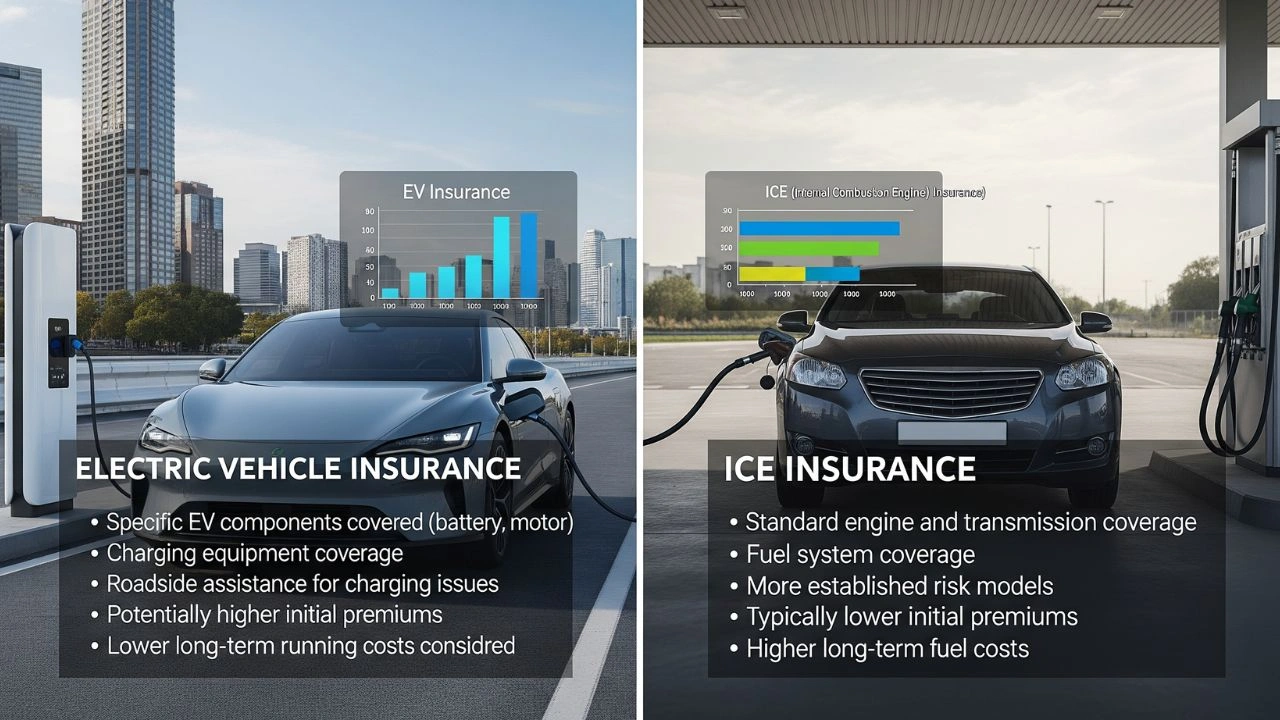
Electric Vehicle Insurance vs ICE Insurance: Electric and traditional car insurance differ fundamentally because technology, risk profiles, repair economics, and driving data redefine premiums.
The rapid global shift toward electric mobility is not only transforming how vehicles are built and driven, but also how they are insured. While many consumers assume car insurance is a standardized product, the reality is that Electric Vehicle (EV) insurance and Internal Combustion Engine (ICE) vehicle insurance are calculated using entirely different logic. From battery costs and software risks to driving behavior data and environmental incentives, insurers evaluate EVs through a new risk lens.
This article explores in depth why EV insurance premiums are calculated differently from ICE vehicle insurance, how insurers assess risks for both, and what this means for drivers in the evolving automotive landscape.
The Fundamental Difference Between EVs and ICE Vehicles
At the core of insurance pricing lies the nature of the vehicle itself. EVs and ICE vehicles are engineered differently, and this difference reshapes almost every aspect of risk assessment.
ICE vehicles rely on complex mechanical systems such as engines, transmissions, fuel systems, and exhaust components. EVs, by contrast, are dominated by high-voltage batteries, electric motors, advanced electronics, and software-driven systems.
For insurers, this means:
- Different failure probabilities
- Different repair methodologies
- Different cost structures
- Different accident outcomes
Insurance pricing models are built on historical data, and EVs represent a technological leap that challenges decades of ICE-based actuarial assumptions.
How Insurance Premiums Are Traditionally Calculated for ICE Vehicles
ICE insurance pricing is rooted in long-established metrics. Insurers typically evaluate the following factors:
- Driver age, gender, and driving history
- Vehicle make, model, and engine size
- Repair and spare parts availability
- Accident frequency and severity statistics
- Theft rates and resale value
Because ICE vehicles have been mass-produced for over a century, insurers possess extensive actuarial data. Repair costs are predictable, parts are widely available, and mechanic expertise is ubiquitous.
As a result, ICE insurance premiums are relatively stable and standardized, with small adjustments based on regional and individual risk factors.
Read Also: Mahindra XEV 9e: A Futuristic SUV Coupe That Redefines Premium Electric Mobility in India
Why EV Insurance Requires a Completely New Risk Model
Electric vehicles introduce new categories of risk that ICE vehicles simply do not have. Insurers must account for uncertainties that are still evolving.
Key EV-specific risk elements include:
- Battery degradation and failure
- Thermal runaway and fire risks
- High-voltage electrical systems
- Software vulnerabilities and cyber risks
- Limited repair networks
Unlike ICE vehicles, a single damaged battery pack can total an EV, significantly increasing claim severity. This alone reshapes premium calculations.
Battery Technology: The Single Biggest Insurance Cost Driver
The battery is the heart of an EV—and also its most expensive component. In many EVs, the battery accounts for 30–50% of the vehicle’s total value.
Insurance implications include:
- High replacement costs
- Specialized diagnostic requirements
- Limited refurbishing options
- Increased total-loss declarations
Even minor collisions can damage battery casings or cooling systems. Insurers must assume higher average claim payouts, which directly influences premium pricing.
In contrast, ICE vehicle engine damage is often repairable at a fraction of replacement cost.
Repair Complexity and Labor Costs for EVs
EV repairs require:
- Certified high-voltage technicians
- Specialized safety equipment
- Manufacturer-approved repair centers
This creates a narrower repair ecosystem, driving up labor costs and extending repair times.
Longer repair durations also increase:
- Rental car expenses
- Claim handling costs
- Customer dissatisfaction risk
ICE vehicles benefit from a global repair infrastructure, keeping repair costs relatively low and predictable.
Fire Risk and Safety Considerations
While EV fires are statistically less frequent than ICE fires, they are more complex and expensive to manage.
EV fire risks include:
- Thermal runaway events
- Re-ignition hours or days later
- Specialized fire suppression requirements
Insurers must factor in:
- Higher fire-related claim costs
- Storage and quarantine expenses
- Environmental remediation
ICE vehicle fires, while more common, are easier to extinguish and less costly to manage.
Software, Sensors, and Cyber Risk in EVs
Modern EVs are essentially software-defined vehicles. They rely on:
- Over-the-air updates
- Advanced Driver Assistance Systems (ADAS)
- Connectivity and data transmission
This introduces cybersecurity risks, including:
- Hacking vulnerabilities
- Software malfunctions
- Sensor calibration failures
Insurance models must now account for non-physical risks, a factor largely absent in traditional ICE insurance.
Driving Behavior Data and Telematics Advantage
EVs generate vast amounts of real-time data. Insurers increasingly use telematics to assess:
- Acceleration patterns
- Regenerative braking behavior
- Speed consistency
- Charging habits
This allows for usage-based insurance models, where safer EV drivers can receive lower premiums.
ICE vehicles also use telematics, but EV data is more granular and continuous, enabling more precise risk scoring.
Environmental Incentives and Regulatory Influence
Governments worldwide promote EV adoption through:
- Tax incentives
- Subsidies
- Reduced registration fees
Some insurers reflect this policy environment by offering:
- Green insurance discounts
- Lower liability premiums
- Special EV coverage bundles
ICE vehicles face increasing regulatory pressure, including emissions penalties and usage restrictions, which can raise long-term insurance risk profiles.
Accident Frequency vs Accident Severity
Early data suggests that:
- EVs may have lower accident frequency due to advanced safety features
- But higher accident severity due to repair and battery costs
This paradox complicates premium calculations. Insurers must balance fewer claims against much higher average claim values.
ICE vehicles tend to have:
- Higher claim frequency
- Lower average repair costs
This fundamental difference reshapes actuarial modeling.
Total Cost of Ownership and Its Insurance Impact
Insurance is part of the total cost of ownership (TCO). While EVs offer:
- Lower fuel costs
- Reduced maintenance
They often face:
- Higher insurance premiums
Insurers recognize that EV owners may be more affluent and tech-oriented, influencing liability exposure and coverage preferences.
ICE vehicles, especially mass-market models, benefit from economies of scale that stabilize insurance pricing.
Market Maturity and Data Limitations
ICE insurance benefits from over 100 years of claims data. EV insurance, by comparison, operates with:
- Limited long-term datasets
- Rapidly evolving vehicle designs
- Changing battery technologies
This uncertainty leads insurers to price conservatively, often resulting in higher premiums until data maturity improves.
Specialized EV Insurance Products Emerging
To address these challenges, insurers are developing:
- Battery-specific coverage
- Charging equipment insurance
- Software and cyber protection add-ons
These specialized products do not exist in traditional ICE insurance, further highlighting how premium structures differ.
Resale Value and Depreciation Risk
EV resale values are influenced by:
- Battery health
- Software updates
- Charging infrastructure availability
Insurers must estimate faster or unpredictable depreciation, affecting comprehensive and collision coverage costs.
ICE vehicles follow well-understood depreciation curves, simplifying valuation and claims settlement.
Charging Infrastructure and External Risk Factors
EV insurance also considers risks beyond the vehicle itself, including:
- Home charging station damage
- Public charging liability
- Electrical surge risk
These external exposure points expand the insurance risk perimeter, unlike ICE vehicles that rely on standardized fueling systems.
Read Also: Ultraviolette F77: India’s High-Performance Electric Motorcycle That Redefined Electric Riding
The Future of Insurance Pricing: Convergence or Divergence?
As EV adoption grows and data improves, insurance premiums may stabilize. However, the fundamental differences in vehicle architecture suggest that EV and ICE insurance will never fully converge.
Future trends include:
- AI-driven risk assessment
- Real-time premium adjustments
- Personalized EV insurance plans
ICE insurance may gradually decline in relevance as fleets electrify, but the pricing logic will remain distinct.
What Consumers Should Understand Before Buying an EV
Prospective EV owners should:
- Compare specialized EV insurance quotes
- Understand battery and repair coverage
- Evaluate telematics-based discount
Choosing the right insurer can significantly reduce EV ownership costs, even in a higher-premium environment.