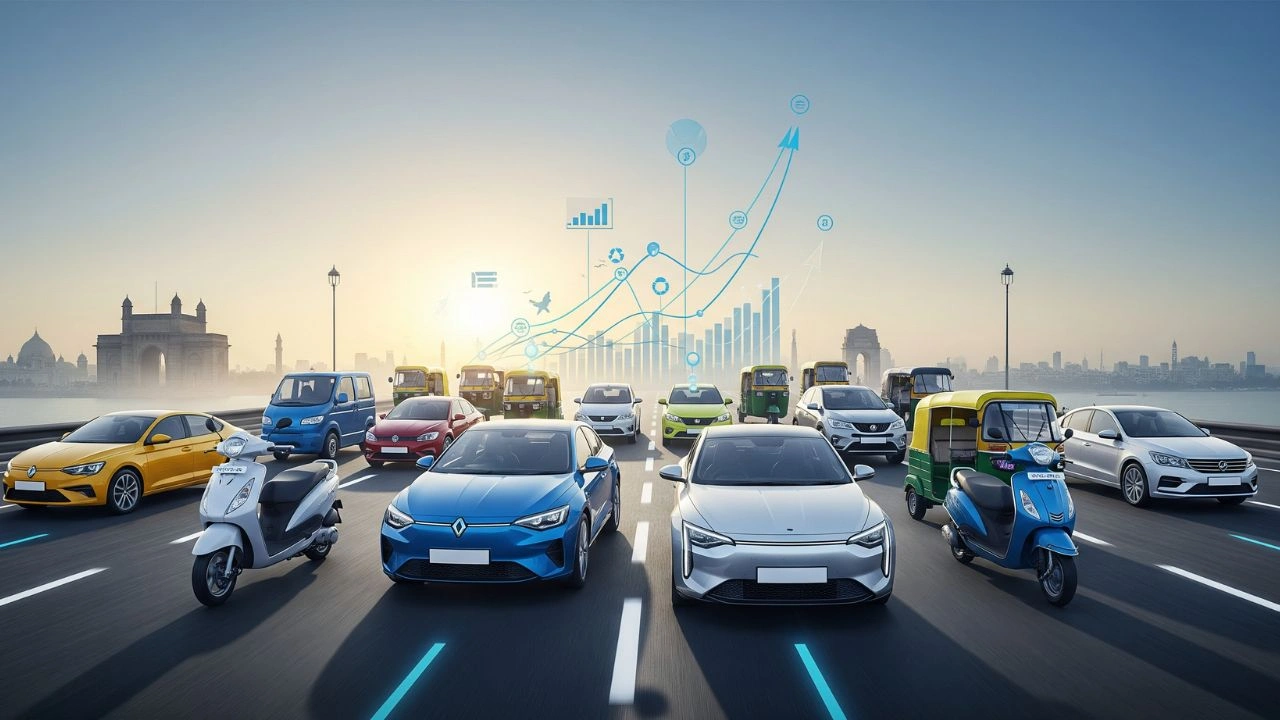
India EV market growth: India’s electric passenger vehicle market records explosive year-on-year growth in January, signaling a decisive shift toward cleaner mobility.
India’s electric vehicle (EV) transition entered a decisive new phase in January 2026 as electric passenger vehicle sales jumped by 51% compared to the same month last year, underlining how rapidly electric mobility is moving from early adoption to mainstream acceptance. The surge was led overwhelmingly by domestic automaker Tata Motors, which further consolidated its leadership position in the country’s fast-evolving EV landscape.
With more than 18,000 electric cars and SUVs registered in a single month, India’s EV market is no longer defined by cautious experimentation. Instead, it reflects growing consumer confidence, expanding infrastructure, and a wider range of electric models that cater to diverse price points and usage needs.
January 2026: A Defining Month for Electric Passenger Vehicles
January 2026 proved to be a landmark month for India’s electric passenger vehicle segment. Total EV car registrations climbed sharply compared to January 2025, when sales were still recovering from supply chain disruptions and limited consumer awareness.
This year’s strong performance highlights a structural change in buyer behavior. Electric cars are increasingly view not just as environmentally friendly alternatives, but as practical, reliable, and economically sensible vehicles for daily use.
Industry analysts note that the January figures are especially significant because they came without the boost of major festive-season discounts, suggesting that demand is being driven by fundamentals rather than temporary incentives.
Read Also: Electric Vehicle Subsidies in India: A Complete Guide 2026
Tata Motors: The Unchallenged Leader of India’s EV Market
At the center of India’s EV growth story stands Tata Motors, which once again emerged as the undisputed market leader. The company accounted for over 40% of all electric passenger vehicles sold in January 2026, reinforcing its dominant position.
Tata’s success is built on a carefully structured portfolio that spans multiple segments—from entry-level hatchbacks to compact SUVs and premium electric offerings. Models such as the Tiago EV, Punch EV, Nexon EV, and newer electric SUVs have allowed Tata to appeal to first-time EV buyers as well as upgrade customers.
What sets Tata apart is not just volume, but ecosystem readiness. The brand benefits from early investments in EV platforms, localized battery supply chains, and strong after-sales support, all of which reduce ownership anxiety for new buyers.
MG Motor Holds Strong with Consistent Performance
Securing second place in the EV sales rankings, MG Motor India maintained a solid presence in January 2026. While its year-on-year growth was relatively modest compare to some competitors, MG’s ability to sustain sales volumes reflects brand stability and customer trust.
MG’s electric offerings are often position as feature-rich and premium-focused, appealing to urban buyers seeking advanced technology, comfort, and safety. The company has also invested in strengthening its charging ecosystem partnerships, which has helped reassure customers concerned about long-distance usability.
Despite intense competition, MG’s consistent performance demonstrates that the Indian EV market is now large enough to support multiple strong players, not just a single dominant brand.
Mahindra’s Breakout Moment: Triple-Digit Growth Signals a Comeback
One of the most striking developments in January 2026 was Mahindra & Mahindra’s dramatic surge in EV sales, registering growth of several hundred percent compared to the previous year.
This remarkable rise was driven by purpose-built electric SUVs, designed from the ground up rather than adapted from internal combustion platforms. These vehicles resonated strongly with Indian consumers who prioritize road presence, performance, and safety.
Mahindra’s rebound illustrates a key lesson in the EV transition: product relevance matters more than legacy brand strength. By aligning design, performance, and pricing with consumer expectations, Mahindra has positioned itself as a serious long-term contender in the electric SUV space.
Emerging Players Begin to Make Their Mark
Beyond the top three manufacturers, January 2026 also highlighted the gradual entry of new and international EV brands into the Indian market.
Vietnamese automaker VinFast, for instance, recorded a noticeable number of registrations, outperforming several well-established global brands. This performance suggests that Indian buyers are increasingly open to new entrants, provided the product offering aligns with value expectations.
At the same time, brands such as Hyundai, BMW, and other premium manufacturers posted moderate volumes, reflecting the cautious pace at which higher-priced EVs are gaining traction in a price-sensitive market like India.
Tesla and the Reality of Premium EV Adoption
Much attention has been paid to the arrival of Tesla in India, but January’s data underscores a sobering reality: premium EV adoption remains limited.
Tesla recorded only a small number of registrations, highlighting challenges related to pricing, infrastructure expectations, and brand positioning. While interest in premium electric cars exists, mass adoption in India remains firmly concentrated in the affordable and mid-range segments.
This trend reinforces the importance of localized pricing strategies and market-specific product development for global EV manufacturers looking to succeed in India.
EVs Now Account for a Growing Share of Passenger Vehicle Sales
Electric cars may still represent a minority of total passenger vehicle sales, but their share is steadily increasing. EVs now contribute around 5% of overall passenger vehicle registrations, a significant improvement from just a few years ago.
This growth is particularly impressive given India’s traditionally conservative car-buying culture. Analysts believe that once EV penetration crosses the 10% mark, adoption could accelerate rapidly due to economies of scale, improved resale value perceptions, and expanded charging coverage.
Infrastructure Expansion Plays a Critical Role
One of the most encouraging aspects of India’s EV growth is the parallel expansion of charging infrastructure. Public charging stations are becoming more visible across highways, office complexes, shopping centers, and residential communities.
State governments and private players alike are investing heavily in fast-charging networks, reducing one of the biggest psychological barriers to EV adoption—range anxiety.
For urban users, home charging remains the most convenient solution, while improved public charging options are enabling greater confidence for intercity travel.
Government Policy and Regulatory Support
Policy support continues to be a cornerstone of India’s EV momentum. Central and state governments have introduced a mix of financial incentives, tax benefits, and regulatory measures aimed at accelerating EV adoption.
Even as direct subsidies are gradually rationalize, long-term policy clarity has encourage manufacturers to commit significant capital toward electric mobility. Clear emission targets and future regulatory roadmaps further strengthen the case for EV investments.
Importantly, policy measures now extend beyond vehicles to include battery manufacturing, recycling, and grid integration, helping build a comprehensive EV ecosystem.
Changing Consumer Priorities Drive Demand
The rapid growth of EV sales reflects a shift in how Indian consumers evaluate vehicle ownership. Rising fuel prices, increasing maintenance costs, and heightened environmental awareness have pushed buyers to consider alternatives to traditional petrol and diesel cars.
Electric vehicles offer lower running costs, quieter operation, and fewer mechanical components, making them attractive for long-term ownership. As awareness improves, buyers are increasingly factoring in total cost of ownership rather than focusing solely on upfront price.
Positive ownership experiences shared by early adopters have also played a crucial role in building trust among prospective buyers.
Automakers Double Down on Localization
To sustain growth and protect margins, automakers are accelerating efforts to localize EV components, particularly batteries and power electronics. Localization reduces costs, improves supply chain resilience, and aligns with government initiatives promoting domestic manufacturing.
Several manufacturers have announced investments in battery assembly plants and partnerships with energy companies, signaling a long-term commitment to India’s EV market.
These moves are expect to gradually reduce EV prices, making electric cars accessible to a broader segment of consumers.
Competitive Landscape Set to Intensify
As EV adoption accelerates, competition among automakers is expect to intensify. New launches across segments—from compact city cars to premium SUVs—are plan over the next 12 to 18 months.
This increased competition is likely to benefit consumers through better features, improved range, and more competitive pricing. At the same time, weaker players may struggle to keep pace, leading to consolidation within the market.
Environmental and Economic Impact of EV Growth
Beyond sales figures, the rise in EV adoption carries broader implications for India’s economy and environment. Reduced reliance on fossil fuels helps improve air quality and lowers greenhouse gas emissions in densely populated cities.
From an economic perspective, EV growth supports energy independence by reducing oil imports and creates new employment opportunities in emerging sectors such as battery technology, charging infrastructure, and software development.
Read Also: Skoda Kylaq CNG May Be on the Horizon as Brand Explores Affordable Mobility Options
Outlook: Is This Just the Beginning?
Industry experts believe that January 2026 could mark the beginning of a sustained high-growth phase for electric passenger vehicles in India. With strong players scaling up, infrastructure expanding, and consumer confidence rising, EV sales are expect to continue climbing throughout the year.
While challenges remain, the overall direction is clear: electric vehicles are no longer a fringe category in India’s automotive market.
Conclusion: India’s EV Market Enters a New Era
The 51% year-on-year surge in electric car sales in January 2026 signals a transformative moment for India’s automotive industry. Led by Tata Motors and supported by a growing cast of competitors, the EV market is gaining both scale and credibility.
As technology improves and costs decline, electric vehicles are poise to become a central pillar of India’s mobility future. January’s performance is not just a strong start to the year—it is a clear indicator that India’s electric revolution is well underway.
2 thoughts on “India EV Market Surges 51% in January 2026 as Tata Motors Dominates”