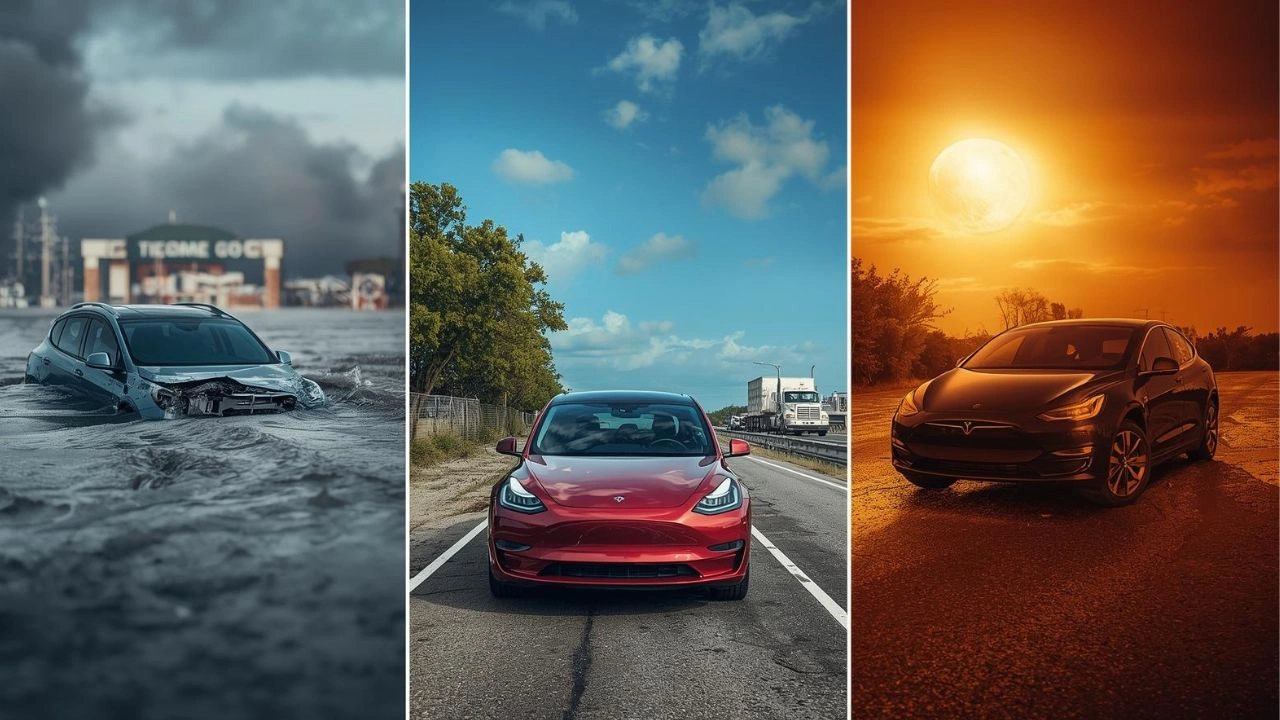
Natural Disaster Coverage for EVs: Electric vehicles (EVs) are often praised for their efficiency, low running costs, and environmental benefits. However, as EV adoption accelerates worldwide, a less discussed but increasingly critical issue is how natural disasters affect electric vehicles—and how insurance responds when they do. Floods, extreme heatwaves, wildfires, cyclones, and unexpected climate events pose unique and sometimes underestimated risks to EVs, especially due to their high-voltage battery systems and complex electronics.
Traditional motor insurance was designed around internal combustion engine (ICE) vehicles. While insurers have adapted policies for electric cars, coverage gaps still exist when EVs face natural disasters, particularly when battery damage is involved. In many cases, EV owners discover these gaps only after a claim is rejected or partially settled.
This article explores natural disaster coverage for EVs, focusing on flood damage, heatwaves, and battery failure risks, and explains how insurers assess claims, why disputes arise, and what EV owners can do to protect themselves.
Understanding Natural Disaster Risk in Electric Vehicles
Electric vehicles are fundamentally different from petrol or diesel cars in how they respond to environmental stress. At the core of every EV lies a large lithium-ion battery pack, supported by high-voltage cabling, power electronics, thermal management systems, and sensitive software controls.
While EVs are engineered with safety in mind, natural disasters introduce unpredictable conditions that go beyond standard driving scenarios.
Key EV-specific vulnerabilities include:
- High-voltage battery exposure to water
- Thermal instability during extreme heat
- Software and sensor failures due to humidity or heat
- Risk of delayed fires after damage
- Higher replacement costs compared to ICE vehicles
Insurance policies may technically include natural disaster coverage, but the interpretation of battery damage and safety risk varies widely between insurers.
Read Also: Mahindra XEV 9e: A Futuristic SUV Coupe That Redefines Premium Electric Mobility in India
Flood Damage and Electric Vehicles: A High-Risk Scenario
Flooding is one of the most common natural disasters globally, and it presents the highest insurance risk for EVs.
How Floods Affect EVs
Most modern EVs have sealed battery packs designed to withstand splashes, rain, and shallow water exposure. However, prolonged submersion or fast-moving floodwater can compromise seals, connectors, and battery housings.
Potential flood-related EV damage includes:
- Water intrusion into the battery pack
- Short circuits in high-voltage systems
- Corrosion of battery cells and busbars
- Damage to inverters and onboard chargers
- Sensor and software malfunction
- Structural damage affecting battery alignment
Even if an EV appears to function after a flood, latent battery damage may surface weeks or months later, increasing fire risk.
Why Insurers Often Total Flood-Damaged EVs
Unlike ICE vehicles, where engines can sometimes be dried and rebuilt, insurers are extremely cautious with flood-exposed EV batteries.
Many insurers classify flood-damaged EVs as constructive total losses, even if visible damage is minimal.
Reasons include:
- Inability to visually inspect internal battery cells
- Risk of thermal runaway after hidden corrosion
- Manufacturer guidelines advising battery replacement after submersion
- High cost of battery replacement (30–50% of vehicle value)
- Legal liability if a repaired EV later catches fire
As a result, flood claims for EVs are more likely to result in total loss settlements, which directly affects premiums and policy renewals.
Heatwaves and Extreme Temperatures: A Growing EV Insurance Challenge
Climate change has increased the frequency and intensity of heatwaves worldwide. While EVs are tested for high temperatures, sustained extreme heat creates new insurance concerns.
Impact of Heat on EV Batteries
Lithium-ion batteries operate within a narrow optimal temperature range. Prolonged exposure to extreme heat can cause:
- Accelerated battery degradation
- Breakdown of electrolyte materials
- Reduced charging efficiency
- Expansion and contraction of battery cells
- Increased internal resistance
- Higher risk of thermal runaway under stress
Heat-related battery damage is often gradual, making it difficult to link directly to a single event—something insurers closely scrutinize.
Insurance Coverage Challenges During Heatwaves
Most motor insurance policies do not explicitly list heatwaves as a covered peril. Instead, claims are evaluated under broader categories such as accidental damage or natural calamities.
This creates complications when EV owners file claims for:
- Sudden battery failure after extreme heat
- Loss of driving range
- Charging system malfunctions
- Fire incidents linked to overheating
Insurers may argue that heat-induced battery degradation is “wear and tear”, which is typically excluded from coverage. Unless the policy clearly includes climate-induced damage, claims may be denied or partially settled.
Battery Failure Risks Triggered by Natural Disasters
Battery failure is the most expensive and contentious issue in EV insurance. Natural disasters significantly increase this risk, often in ways that are not immediately visible.
Types of Disaster-Related Battery Failures
Flood-Induced Failure
- Internal corrosion
- Insulation breakdown
- Delayed short circuits
Heat-Induced Failure
- Thermal stress fractures
- Degraded separators
- Increased fire susceptibility
Post-Disaster Charging Risks
- Charging a compromised battery can trigger thermal runaway
- Fire may occur hours or days later, complicating claim attribution
Insurers increasingly rely on forensic battery diagnostics, but these tests are expensive and not always conclusive.
Thermal Runaway After Natural Disasters
Thermal runaway is one of the most feared outcomes for insurers. Natural disasters significantly increase this risk.
Thermal runaway occurs when:
- Battery temperature rises uncontrollably
- Chemical reactions accelerate
- Heat spreads from one cell to another
- Fire or explosion occurs
Flood-damaged or heat-stressed batteries are far more susceptible, even if no immediate malfunction is detected.
For this reason, many insurers refuse to repair disaster-exposed batteries, opting instead for total loss settlements or claim rejections if policy terms allow.
How Insurance Policies Define Natural Disaster Coverage for EVs
Most comprehensive motor insurance policies include natural disasters under terms such as:
- Flood
- Storm
- Cyclone
- Earthquake
- Landslide
- Fire due to natural causes
However, EV-specific wording matters.
Common Policy Clauses That Affect EV Claims
- Exclusion of “electrical or electronic failure unless caused by an external event”
- Exclusion of “consequential damage”
- Wear-and-tear exclusions applied to batteries
- Manufacturer advisory clauses
- Requirement for immediate inspection after water exposure
If an EV owner continues driving or charging after a disaster, insurers may argue negligence, reducing or rejecting claims.
Flooded Home Charging Stations and Secondary Damage
Natural disasters often affect not only the vehicle but also home charging infrastructure.
Flooded or heat-damaged chargers can:
- Send unstable current to the EV
- Damage onboard chargers
- Trigger battery faults
- Cause electrical fires
Insurance responsibility may be split between:
- Motor insurance (vehicle damage)
- Home insurance (charging equipment and wiring)
- Manufacturer warranty (limited and conditional)
Disputes often arise when insurers argue that the damage originated outside the vehicle, shifting liability elsewhere.
Premium Impact of Natural Disaster Exposure
EV insurance premiums are directly influenced by natural disaster risk.
Insurers analyze:
- Geographic flood risk zones
- Heatwave frequency
- Urban drainage quality
- Garage or open parking exposure
- Historical claim data for EVs in the area
In high-risk zones, EV owners may face:
- Higher premiums
- Increased deductibles
- Mandatory add-ons
- Lower insured declared value (IDV)
- Stricter claim conditions
Some insurers now apply EV-specific catastrophe loading, especially for flood-prone regions.
What EV Owners Can Do to Reduce Claim Risk
While natural disasters are unavoidable, proactive steps can significantly improve insurance outcomes.
Best practices include:
- Avoid driving or charging after flood exposure
- Document water levels and damage immediately
- Inform the insurer without delay
- Do not attempt DIY drying or repairs
- Park in covered or elevated areas when possible
- Install surge and flood protection for home chargers
- Choose policies with explicit EV battery coverage
Most importantly, read battery-related exclusions carefully before purchasing insurance.
Read Also: Ultraviolette F77: India’s High-Performance Electric Motorcycle That Redefined Electric Riding
The Future of Natural Disaster Coverage for EVs
As EV adoption grows and climate risks intensify, insurers are rethinking coverage models.
Emerging trends include:
- Dedicated EV disaster riders
- Battery-specific insured value
- Usage-based and climate-risk pricing
- Mandatory post-disaster battery inspections
- Collaboration with EV manufacturers for diagnostics
Regulators in several markets are also pushing for clearer disclosure of EV insurance limitations, particularly around flood and heat-related damage.
Conclusion: A New Insurance Reality for EV Owners
Natural disasters pose fundamentally different risks to electric vehicles compared to traditional cars. Floods, heatwaves, and climate extremes can trigger battery failures that are costly, dangerous, and difficult to assess.
While most comprehensive policies claim to cover natural disasters, EV owners must look beyond generic wording. Battery exclusions, thermal risk clauses, and post-disaster usage conditions often determine whether a claim is approved or denied.
As climate volatility increases, understanding natural disaster coverage is no longer optional for EV owners—it is essential. Choosing the right policy today can mean the difference between full protection and a devastating financial loss tomorrow.